
Anyone who has spoken with me, even briefly, knows about my passion for scuba diving. Some call it “obsession,” but to me, it’s more like an endless love affair with the ocean. From the time I was a toddler, the sea has always been my happy place. But it wasn’t until one unforgettable trip to the Gulf of Aqaba that everything changed. I jumped in the sea with a snorkel and suddenly found myself surrounded by a riot of colours: corals, fish, sponges and life so abundant and so close… That moment I knew I had to find a way to spend as much of my life underwater as possible.
Almost 17 years have passed since my first dive, and I still remember my very first breath underwater. I put the regulator in my mouth, inhaled, and felt the surprising yet exhilarating realization: I can breathe down here. The mixture of shock, joy, and freedom was indescribable. Since then, I’ve logged over 570 dives across the globe, journeying from the very first Open Water Diver course all the way to becoming an instructor. Each dive has taught me something new—not only about the sea, but also about myself and the community that surrounds this incredible activity.
“It’s just you, your breath, and the ocean.”
Endless discovery
The ocean covers more than 70% of our planet, which means there is much to explore. And besides, even in the same spot no two dives are ever the same: conditions change, wildlife appears or behaves in different ways, and light paints the landscape differently. Sometimes it’s calming, drifting slowly across a reef. Other times, it’s an adrenaline-fuelled adventure, swept along by strong currents or descending deep into the blue. Indeed, a world where there is always something new to discover.
Calm in the blue
There is something deeply healing about being underwater. Psychologists say blue is a calming color, and it is well known that deep, slow breaths helps with relaxation and mindfulness. Diving taught me the true meaning of living in the moment. Down there, weightless and silent, worries fade. Phones don’t ring, emails don’t arrive. It’s just you, your breath, and the ocean. That sensation of floating free, suspended in the water, gives me a sense of freedom and pure joy.
Encounters with wildlife
And then there’s the magic and the privilege of encounters with marine wildlife. Each one feels like a gift, because it always happens on their terms, not ours. Sometimes it’s a curious lobster checking you out with its antennae. Another moment, it’s an oceanic manta ray gliding just above your head, a enjoying the tickle of your bubbles. I’ve danced playfully with a gentle dugong, watched in awe as a longimanus shark circled around me with curiosity, and even been fiercely chased off by a clownfish defending its tiny home. These moments make you feel connected, part of the ocean, yet you realize that you are just a visitor.
Growth through diving
Every dive is a lesson that resonates in daily life. It can be practical—like refining your technique. Or it’s about nature itself, like when you see a species for the first time. The skills you acquire while scuba diving are the same ones you can take advantage of in everyday life:
Communication: underwater, you can’t rely on words. Divers use hand signals, but there is no universal standard, so agreeing with your buddy before the dive is essential. It teaches you to be clear, adaptable, and empathetic.
Risk awareness: divers learn to respect the environment, to use life supporting equipment and to sharpen their awareness of the surroundings, their own physical fitness as well of their mental state, and that of their diving buddies.
Observation: navigation often depends on natural cues—rock formations, sunlight angles, even fish behavior. You learn to notice details others might miss.
Leadership: whether guiding a group or teaching students, leadership in diving is about service. It means keeping others safe, helping them learn and grow, and ensuring they enjoy the adventure.
“The skills you acquire are the same ones you need at work and in everyday life”
A deeper appreciation for the ocean
Diving opens your eyes to the majesty of the sea, its resilience and its fragility. The ocean provides us with so much: apart from food and climate regulation it is the planet’s largest carbon sink, absorbing vast amounts of CO₂. At the same time, it is also vulnerable to overfishing, pollution, and climate change. But the ocean can also recover very quickly if actions are taken. Divers become advocates, not just explorers, because we see firsthand what’s at stake. The ocean is far greater than any of us, and it is our role to observe, learn, respect and protect.
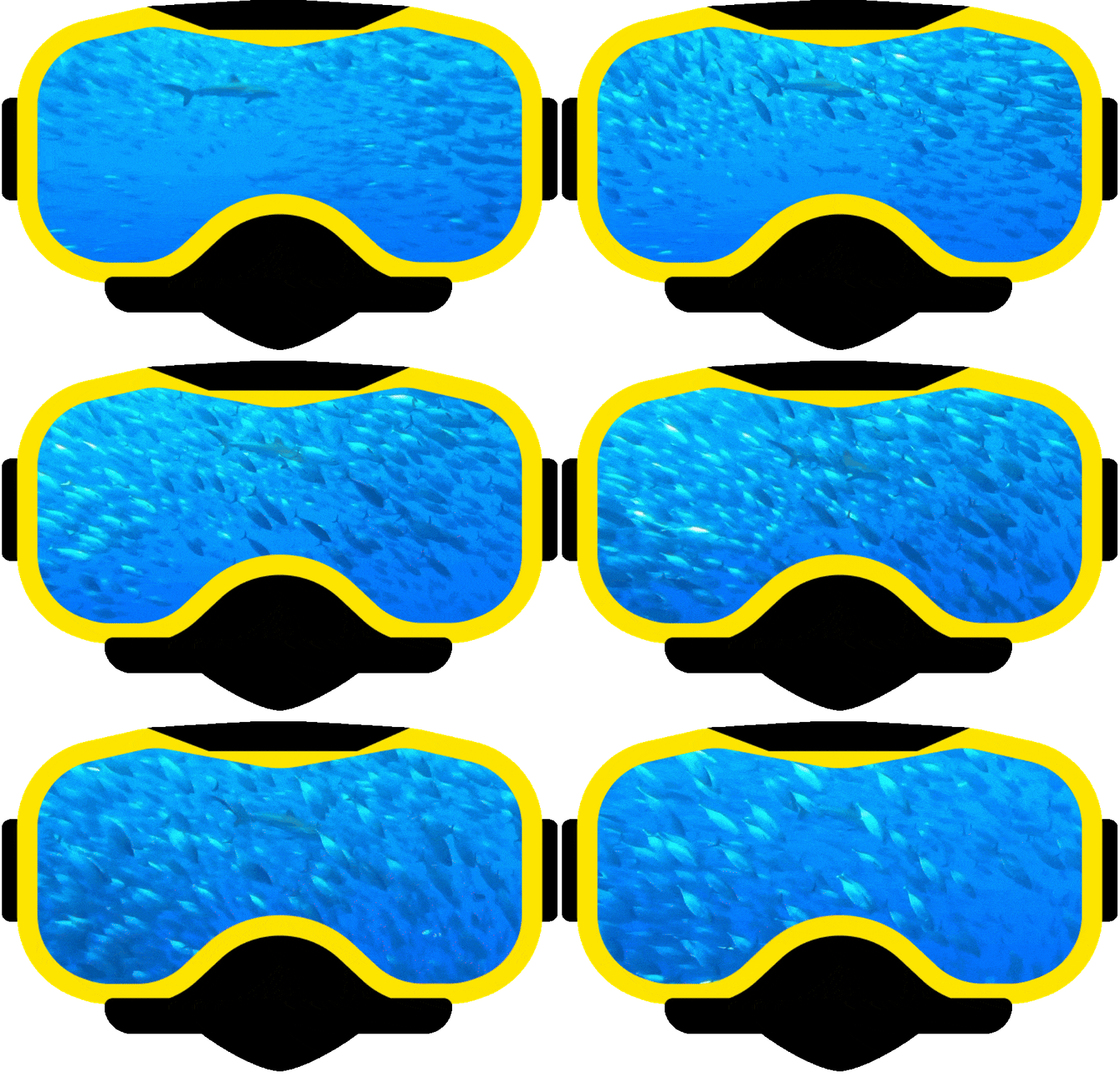
Observe, learn, respect and protect
Technological ingenuity lets us experience a world we weren’t built to survive in.
Scuba diving cannot exist without science and technology, if only because we are not made to survive in the underwater world. That is why the industry constantly innovates, creating new materials, safer equipment, and better ways to understand how our bodies respond to breathing gases under pressure. I personally like the underwater touchscreen smartphone case, allowing me to access all smartphone functions without limitations. This technology has unlocked the potential of powerful smartphone operating systems to perform underwater photography, entertainment, communication, and research, with endless possibilities.
An important innovation for safety is satellite connectivity, which automatically records the dive entry and exit positions. This helps, for example, in finding divers who have drifted away from their boat. With SubWave, a sonar-based wireless technology, divers and surface crew can monitor tank pressure and diver depth, exchange preset messages, and more. A buoy with a transmitter can extend the range of messages between divers to 100 meters. Divers can also track the buoy’s position to navigate back to it. The Garmin Dive™ app even provides a heat map after the dive to show which areas have already been explored and which are still to be discovered.
Four interesting facts about scuba diving
SCUBA stands for Self-Contained Underwater Breathing Apparatus, a concept pioneered by Jacques Cousteau, whose inventions opened the underwater world to millions.
The ocean as a carbon sink: Our seas absorb around 25–30% of the carbon dioxide we emit, playing a vital role in regulating Earth’s climate.
Diving is accessible to almost everyone. Regardless of age, gender, or body type, people can dive as long as they are reasonably fit. Many training agencies offer programs for those with physical disabilities, proving that the underwater world truly belongs to all of us.
Never dive alone: By definition, you cannot dive alone and divers share an unspoken bond, built on love for the ocean. Whether you experience that magic encounter, plan a dive with a buddy, or join a reef cleanup effort, there is always a sense of belonging that is rare and special.